



In this guest blog, Stefano Frau documents the implementation of Optibus at FNMAutoservizi (FNM Group) as part of his university thesis, academic year 2024/2025.
Every summer, rail networks across Europe shut down stretches of track for maintenance. Trains stop running, but passengers don't stop needing service. Getting them where they need to go falls to bus operators, who have a matter of weeks to stand up a substitute service that runs like clockwork, often across long, unfamiliar corridors, with borrowed vehicles and bus drivers who may be lodging far from home.
It is one of the hardest planning problems in public transport. One that reveals what a scheduling platform is really made of.
I studied this up close as part of my university thesis, documenting the rollout of Optibus at FNMAutoservizi, the bus operator within Italy's FNM group in Lombardy. I spent months tracing what changed, why, and the impact. Here is what stood out to me.
Two corridors, one summer, no room for error
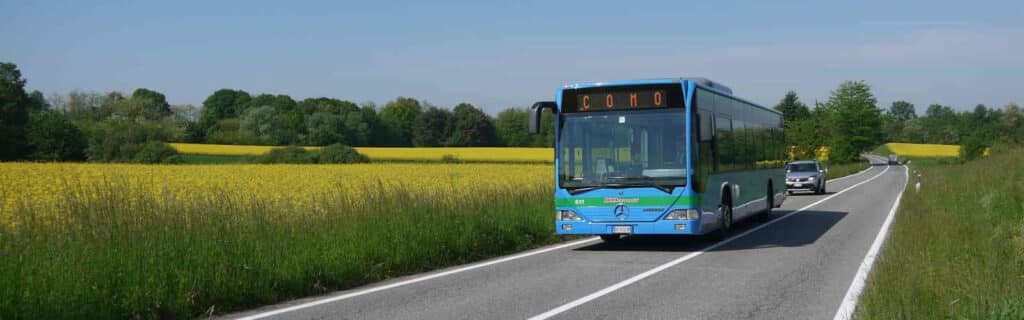
In summer 2025, FNMAutoservizi faced major planned rail closures on two corridors at once:
- Arona–Domodossola, running from 8 June to 15 September, requiring 21 buses and 32 drivers.
- Lecco–Sondrio–Tirano, running from 15 June to 14 September, requiring 47 buses and 81 drivers.
That is more than 60 vehicles and over 110 drivers deployed across three months on routes that don't normally exist. The plan was built from scratch, costed, staffed, and designed to stay compliant with driving-hours rules the entire time.
The Lecco–Sondrio–Tirano operation added a further obstacle: drivers coming in from outside the region needed accommodation, so the plan had to account for overnight rest and vehicle security, not just the runs themselves.
This is where substitute services usually get expensive and messy. The timetable arrives as a static document. Someone has to translate it into vehicle blocks, then driver duties, then a cost per operator. This is often done by hand, under time pressure, and with just enough ambiguity to invite mistakes.
Turning a timetable into a plan, automatically
The workflow is straightforward. The inputs were the substitute-service schedule and the list of trips per period. From there, the vehicle blocks became the pivot point: assign the services correctly, quantify the economics, and monitor how vehicles were distributed across the territory.
The difference from the old way of working is the whole story. Before, extra runs and daily variations were typed into spreadsheets and hand-passed to payroll, a slow chain with multiple chances for transcription errors. With an optimization-driven platform, duties are generated directly from the trips that actually run, and cost figures draw on the same source of truth.
For an operation that changes week to week, that is the difference between a reliable plan and one that requires constant patching.
The optimizer as decision-maker, not just calculator
What let FNMAutoservizi move this fast was the ability to encode its rules once and let the optimizer work within them. The operator built reusable operating models: one set of rules for school services, another for rail replacement, another for seasonal peaks. Each carried the relevant regulatory and contractual constraints.
Those constraints are not trivial. Italian operators work under layered rules: EU Regulation 561/2006 on longer routes, national law, the sector labor agreement, and detailed company-level agreements covering daily driving limits, rest, accessory time, and overtime. The platform turns all of that into logic a planner can rely on and makes trade-offs visible.
Consider the penalty system: assign a cost, say €100, to any duty exceeding twelve hours of spread, and the optimizer will avoid those solutions unless there's a good reason not to. The result is a plan that's balanced, compliant, financially defensible, and one a planner can adjust in the open rather than in a black box.
The same engine handles a challenge that is only going to grow: electric vehicles. Planning e-buses means respecting charging times, station locations, minimum battery levels, and vehicle availability along the line. Done badly, adding electric bus service means adding vehicles and drivers to cover the gaps. Done with optimization, the charging and continuity constraints are solved together, in one integrated plan.
The human payoff
It would be easy to read all this as a story about speed. It is really a story about trust.
When rotations are built to a consistent, transparent rule rather than assembled by hand each month, drivers can see that the workload is shared fairly. When a driver app puts the day's assigned duties in every driver's hand, with routes, stops, closures, and the ability to flag a discrepancy on the spot, the conversation between the depot and the road gets faster and cleaner. When every change is logged digitally, the twice-yearly audits that involve stacks of paper become a few minutes in the system.
This optimization relieves planners of repetitive, error-prone work and enables them to direct their time and judgment where it matters most.
The takeaway
A summer of rail replacement is a stress test. It compresses everything hard about transport planning, scale, deadlines, compliance, cost, and human logistics, into a few frantic weeks. Creating a plan you can trust, with drivers who feel fairly treated, and a clear audit trail is a good measure of whether digitalization is real or just installed.
Further Reading:
- E-book: The Control Room Reimagined: A Field Guide to Modern CAD/AVL
- Webinar: Real-Time Visibility, No New Hardware: A Live Look at the Optibus Real-Time Suite