




APTA TRANSform & EXPO brought more than 800 exhibitors to McCormick Place in Chicago from October 4 to 7. We spent the week on the show floor, in sessions and in conversations with agency leaders, schedulers, operations managers, consultants and our own customers. Here are the trends that stood out.
1. Modernize without starting over
Many agencies we met aren’t starting from scratch. They’re a few years into contracts for CAD/AVL hardware, scheduling software or both. One agency we spoke with is four years into each and wants to move to the cloud, but can’t throw away what it has already paid for.
The question has changed from “what do we replace?” to “how do we get more out of what we already own?” Better ETAs, live fleet visibility, detour detection and less manual reporting can all come from data agencies already collect. The reporting burden is real: a 2022 FTA estimate puts the time agencies spend on NTD reporting at a combined 456,179 hours a year, and compliance was a common topic at our booth.
That’s the thinking behind the Real-Time Suite, which made its debut at the show. It works with an agency’s existing CAD/AVL instead of replacing it.
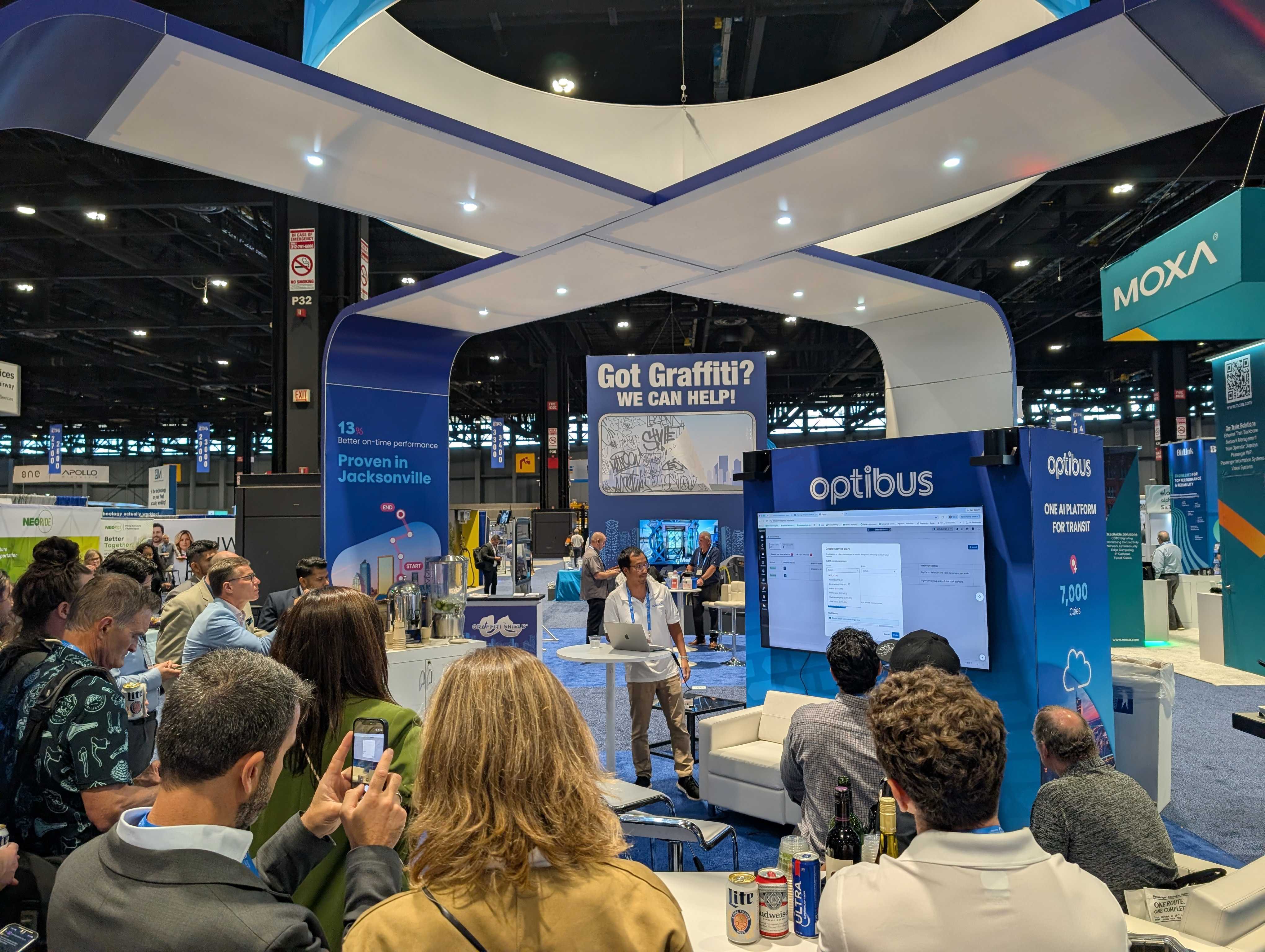
2. Planning and operations are converging
For years, planning and day-of operations ran on separate systems owned by separate teams. That divide is closing.
Consultants advising one of the largest agencies in the US told us the agency is looking for a full feedback loop: plan the service, run it, then feed what actually happened on the street back into the next plan. A county preparing to launch its first fixed-route service said the same thing from the other end of the size range. It wants one system from planning to day-of operations from day one, rather than adding tools one at a time.
The conference itself pointed the same way. Shared data platforms connecting services across a region were a major theme. That theme carries extra weight in Chicago, where transit across the six-county region carries more than 1.3 million rides a day (Urban Transport Magazine).
3. AI moves into daily operations
AI at this year’s show was about specific operational tasks: predictive maintenance, real-time demand planning and resource management. Industry coverage of the show described AI as “a practical operational tool.”
We dedicated a full day to the Optibus Agent and kept the demos at the same level: building scheduling scenarios, finding an available driver, checking punctuality and sending a message to a vehicle. The focus is on removing hours of preparation work while leaving the decisions with planners and dispatchers.
4. The workforce side is still the most manual
Planning tools have come a long way. The work around operators often hasn’t. Several agencies told us their driver bidding is still done by hand. One operator’s agency partner is pushing them to change systems, partly for that reason.
Customers who already bid digitally were thinking about the next step. Their questions were about vacation bidding and how it handles driver hours. Vacation picks are among the highest-stakes and most disputed processes an agency runs. With operator retention still a challenge across the industry, how fair and transparent these processes feel matters more than ever.
5. Growth, new services and more modes
Not every agency is in cost-cutting mode. We met a regional agency tripling its fleet and expanding service, and a county preparing to launch fixed-route service for the first time. Agencies also asked about paratransit and demand-responsive transit alongside fixed route.
Rail came up too. On the floor, rail and fleet infrastructure were everywhere, from battery-electric trains to heavy-duty charging and grid integration. More than 1,600 fully zero-emission buses are now in service in the US, and 52% of US transit buses use alternative fuels or hybrid technology (Urban Transport Magazine).
Growth and new modes add complexity. Agencies want tools that can handle more vehicles, more service types and more modes without a separate system for each.
6. Every investment has to justify itself
Long-term funding and financial resilience were central themes in the TRANSform sessions, as many agencies face budget pressure. Every investment has to justify itself, and we heard that in how agencies approach software decisions.
Software evaluations are becoming broader and more careful. Agencies want to see how a platform works end to end, and they want every team that will use it, from planning and scheduling to operations and IT, to see how it fits their own work. Operators are thinking about value across the whole life of a contract, and they look for tools that support everything from preparing a bid to running the service.
Looking ahead
The common thread across all six trends: agencies want connected, cloud-based systems that build on what they already have. They want AI that does real work, and tools that treat operators and riders as well as they treat the schedule.
Thank you to everyone who stopped by, shared what they’re working on and gave us a lot to think about. If we didn’t get to meet in Chicago, get in touch.
Further Reading: