



During our recent driver bidding webinar, we ran a simple poll: How do you currently run your driver picks?
The results revealed just how varied the industry still is:
- 37% still rely on paper-based bidding
- 11% use pen and paper for parts of the process
- 21% use spreadsheets
- Only 26% use a digital bidding solution today
That means nearly 70% of organizations still run driver picks using methods that require manual entry, coordination, and reconciliation.
At the same time, industry-wide pressures are intensifying. According to the American Public Transportation Association, 96% of transit providers report workforce shortages, and 32% have reduced service as a result. When bus operators are hard to find and even harder to retain, a slow, opaque, or error-prone bidding process becomes more than an inconvenience; it becomes a structural barrier to reliability.
This is why so many teams told us during the webinar: the time for digital bidding has arrived.
Optibus Digital Bidding was designed for exactly this shift.
What’s changing across the industry
Teams are running more frequent picks, variations (including short bids, seasonal bids, and garage-specific bids), and more detailed CBAs than ever before.
In the webinar, 63% of attendees reported running roster-style bidding, 21% cafeteria-style, and 16% hybrid, illustrating just how diverse workflows have become.
Another poll showed that 37% of organizations run two bidding cycles per year, but 47% run three or more, with some running as many as five or six.
Drivers, meanwhile, want more visibility and flexibility, especially when many organizations are still experiencing operator turnover rates above 25% annually.
Digital Bidding meets these evolving needs by providing a clear, adaptable framework for all pick types.
What Digital Bidding actually improves (beyond “going paperless”)
1. Faster preparation
What once took weeks - printing packets, verifying seniority lists, checking rules - now takes hours. Rosters are imported directly, and seniority windows are configured and validated before publishing.
2. Clear visibility for drivers
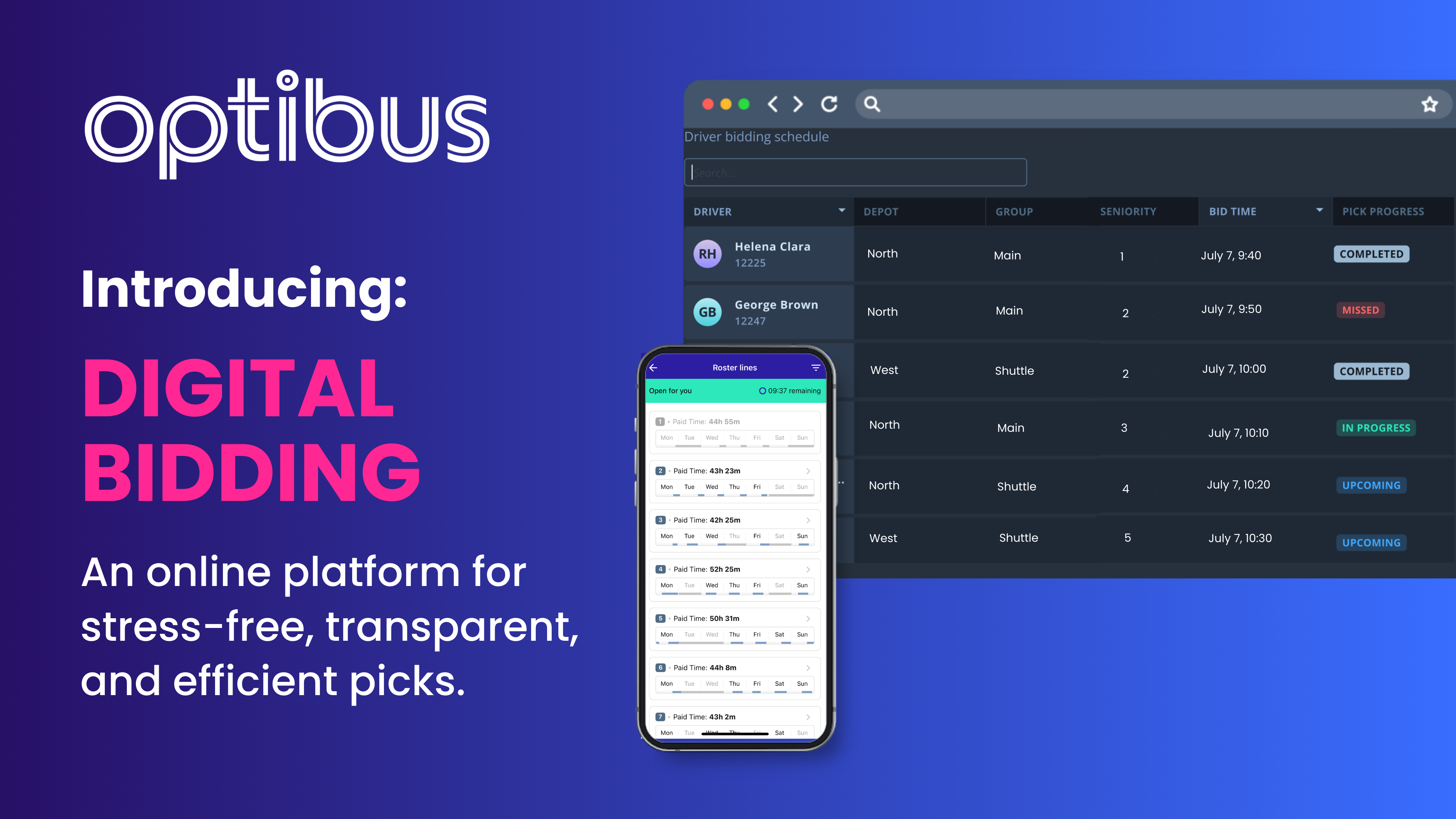
Drivers get early access to roster details: hours, days off, start/end times, run types, breaks, and filters. They arrive at their pick window prepared, not rushed.
3. Automatic compliance
Seniority, duty limits, work-hour rules, and day-off patterns are enforced automatically. Rule violations are flagged immediately, instead of days into the cycle.
4. Real-time monitoring
A live dashboard replaces paper sign-in sheets and color-coded spreadsheets. Teams can see active, upcoming, completed, and missed pick windows in real time.
5. Instant integration with operations
Picks populate operations views immediately; no manual re-entry, no reconciliation, no risk of mismatched data. Many teams report saving 20–40 hours per pick cycle from this alone.
These improvements add up to a faster, clearer, and far more resilient bidding cycle — one that can support the growing complexity of today’s operations environment.
Why organizations are moving now
The broader workforce landscape is accelerating adoption:
- 96% of providers face operator shortages
- 67% say administrative burden is a top challenge
- Many report that bidding day requires paying operators on their day off, an avoidable cost
- Remote access is increasingly expected, especially from younger drivers
- Complex CBAs require rule-based workflows, not manual oversight
Digital Bidding aligns with all these trends, giving teams a more resilient, scalable approach.
What we heard in the webinar
Participants emphasized a few common needs:
- Drivers want time to explore their shift options (which improves satisfaction and reduces errors)
- Teams want to avoid re-running windows or restarting cycles
- Many operators need a system built for multiple pick formats
- Organizations want a clean connection from bidding → operations → payroll
Digital Bidding is built to support all of these requirements.
The bottom line
Driver bidding shouldn’t be a bottleneck, a source of stress, or a multi-week administrative project. With Optibus Digital Bidding, organizations gain a structured, dependable, modern workflow that:
- Cuts prep time significantly
- Reduces manual work and errors
- Gives drivers earlier insight and easier decision-making
Keeps operations aligned with CBAs and shift rules - Scales across any bid type or frequency
And the industry is ready for it: nearly 70% of organizations still using manual or spreadsheet-based processes now have a clear opportunity to modernize.
For more information and to see a demo of Digital Bidding in action, check out our recent webinar available on demand.